| 
Tokugawa Ieyasu and his personal correspondence with James I of England: 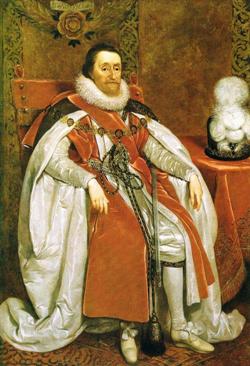
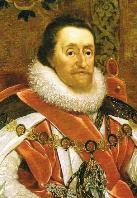
King James I of England, the son of Mary Queen of Scots and Lord Darnley was the successor of Elizabeth I for the rule of England. (1566_1625)
| James I of Engalnd was the son of and successor of Mary Queen of Scots to the Scottish Throne and selected by his cousin Elizabeth I of England as the successor to the throne of England following her death. James ruled Scotland from the time of his mothers execution in 1587 until 1603 when he became the King of England. He ruled England from 1603 until the time of his death in 1625 when his son Charles I became the new King of England. 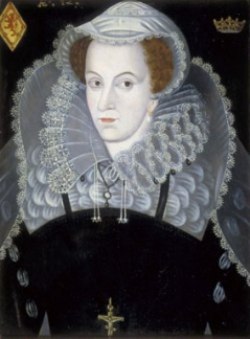
Mary Queen of Scots
| 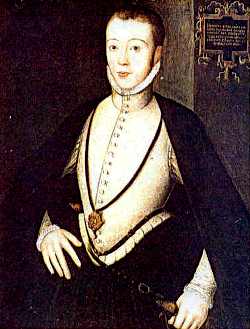 Henry Stuart, (Lord Darnley) James I father | 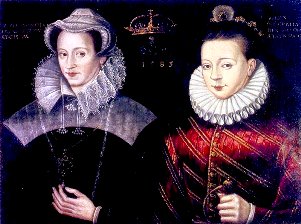 Mary Queen of Scots and her son James VI of Scotland , James I of England 1545 | The historical reviews of the effectiveness of James I rule over England see varied opinions of his success. He actively sought to re-establish diplomatic relationships with Spain and was in effect a Catholic English Monarch. He is credited with being the patron for the compilation of the King James version of the Bible although the translations of the Bible into English from the Greek, Hebrew and Latin had been given a major boost by Henry VIII who had hired the linguist Desiderius Erasmus to translate entire sections of the Bible into English for his personal use. The translations of the Bible used for the Kings James version were made and compiled over many decades of scholarship and the completed translations were finalized, compiled and officially published as the King James Version of the Bible during his reign as the King of England. Most of the linguists and scholars responsible for this effort were associated with Cambridge and Oxford Universities. The rule of James I and his relationship with the Japanese ruler Tokugawa Ieyasu marks an important historic timeline in the relationship between the Christian World, the Rule of Kings, constitutional governments and Japanese society and culture. It should be noted these two men were both rulers at watershed moments in their perspective countries governments and histories. England's fate was to go on to become an effective leader of the world in commerce and class justice and Japan would indulge in an extended period of isolationism imposed by a rural elite that lead to its social irrelevance as a world society by the end of the Edo period and the re-establishment of commercial and governmental contacts with Western European cultures. It is noteworthy that James I conducted correspondence with Tokugawa Ieyasu in personal letters carried to and from the Shogun through the English East India Company. These letters are important historic documents of great significance that are still available for our scrutiny. The exchange of gifts and letters between the two leaders has become the focus of a recent exhibit by the Royal Armouries in Leeds in cooperation with the Nikko Toshogu shrine. During the time of James I rule England's' parliament was dealing with the Catholic influences in its society in much the same way as Ieyasu was dealing with the influences of Catholic Priests and missionaries in his own country. Both came to regard the priesthood of the Catholic Church as a fifth column of Spanish influence in their countries and sought to eliminate the possibility of its success by suppressing the effectiveness of catholic influences in their individual countries. Ieyasu would begin to actively aswage the influences of the Catholic Faith in his country by direct intervention and the wholesale persecution of the Christian influences in Japan. Ieyasu would promote his own diefication and create the Tokugawa dynasty that would last another 250 years throught he end of the Edo period. In England the the movement against the Catholic influences would take the form of the Puritians removing Charles I from rule and trying him for treason against his countrymen and substituting a parlimentary government under Oliver Cromwell. Cromwell's poliical and military campaigns would effectively unite the United Kingdom for the first time in its history. Although James I advocated the concept of "The Divine rule of Kings" and published his own treatise on the concept by the end of James I rule in England the differences between the effects of the protestant reformation and the Catholic Church were more than apparent, entirely new concepts of an individuals personal responsibility and social rights were beginning to be formulated. England's puritan movement, the protestant reformation and Oliver Cromwell effectively removed the concept of "The Divine Right of Kings" by putting Charles I (James I son) on trial for high treason against his own countrymen. 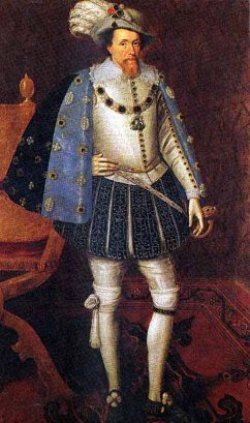 James I, pushed for the concept of the divine rule of Kings | 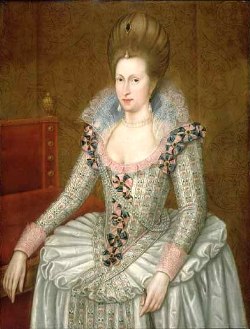 Anne of Denmark Queen Consort of James I of England and mother of Charles I of England | 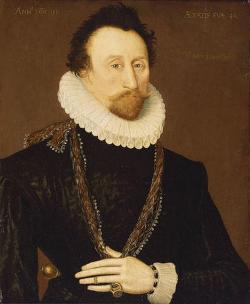 An English Sea Captain and Privateer of the time Sir John Hawkins | Japan on the other hand chose rule by a rural elite buddy system organized around Ieaysu's personal inner circle while England reorganized its government around the new ideals of free trade in commerce, humanism and scientific thinking. England through the Puritan movement deposed the concept of "The Divine Rule of Kings" and established a constitutional government ruled by a parliament. This concept was to be carried to America by these same Puritans and the concept of Constitutional Government run by elected officials of the people was to become the cornerstone of the American political system. With the arrival of William Adams to Japan in 1600 and the assumption his advisory relationship with Ieyasu the body politic of the European Community became a topic of discussion between the two men. Adams favor with Ieyasu was in part because of his unique perspective and his willingness to reveal this information to the Japanese ruler. When John Saris showed up to negotiate trade agreements with Japan for The English East India Company Ieyasu already knew who to send his correspondence to and the two rulers would begin their personal relationship conducted through letters sent by couriers transporting the documents and gifts between the two rulers. Besides the written correspondence on a personal level there were items of interest still in existence today in both England and Japan that changed hands during these political processes. Suits of armor were exchanged and James I sent a clock to Ieyasu that was built in Spain in 1581 which had found its way to into his possession during his political exchanges with Spain. These items are prime examples and remain a testimony of the beginnings of the globalization of trade that has continued to create significant changes in both directions to this day. 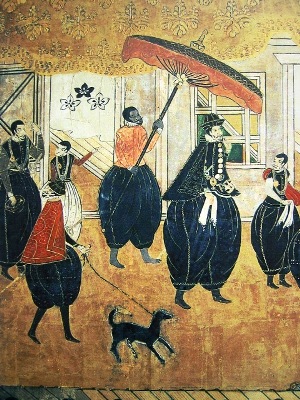
17th Century Japanese painting showing Nanbam influences in Japan |  Tokugawa Ieyasu's statue at the Toshogu Shrine built in 1617 as the mausoleum of the Tokugawa Ieyasu | 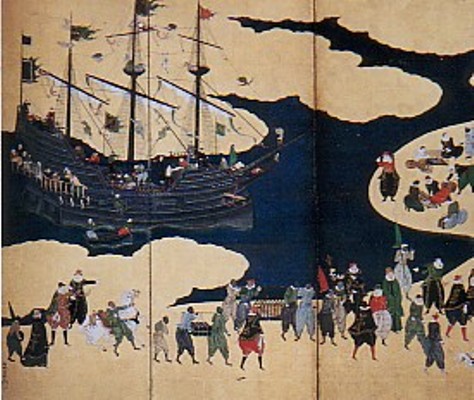
17th Century Japanese byobu ( folding screen ) showing Nanbam arrivals in Japan
|
To assist in putting Kanayama's art objects into historical Context See: The life and times of St. Francis Xavier, 1512- 1552
Page: 1
Xavier meets Otomo Sorin the King of Bungo,1550
Page: 2
William Adams arrives in Japan, 1600
Page: 3 The Epic Journey of Hasekura Tsunenaga, 1613-1620
Page: 4
James I king of England (1603-1625) and his personal correspondence with Tokugawa Ieyasu Shogun of Japan ( 1600-1616)
Page: 5
The life and times of Hosokawa Sansai. (1564 - 1645)
Page 6
This Page was co-authored by Chester Comstock in co-operation with Kanayama, For additional information on Kanayama and his collection of Japanese Antiquities from the 16th and 17th Centuries see Kanayama Discusses Sukashi Tsuba.
Chester Comstock is the Publisher and Editor of Artsales.com and the founder and owner of Comstock Sculpture Studio.
|